
quantity take-off · cost and carbon
Your model, prepared for reliable quantities
Practical BIM is my independent practice near Grenoble, France. I prepare IFC models so that they produce quantities you can trust, trace back to the model and reuse — in your own classification. I work upstream of estimating and life-cycle assessment software, never in place of it.
Get in touchA first review of your project, at no charge.
The problem I solve
A model describes walls, slabs and insulation layers. A cost breakdown asks for plastered surfaces, reveals and lintels, painted soffits, thresholds. Life-cycle assessment (LCA) software asks for materials and masses at a level of detail the model rarely provides. In both cases the information exists in the model, but not in the form the downstream tool expects.
No software resolves this on its own, because the missing link is not geometric. Which cost item a given element maps to depends on how the work is packaged, on local trade practice and on project-specific conventions. It is a judgement. It has to be made once, explicitly, and recorded — otherwise it is made again on every revision, by hand.
What I do
Quantity take-off in your cost classification
I take the cost classification your estimators already use and embed it in the model itself: each element is attached to its items. What comes out is not a spreadsheet: it is a prepared IFC model carrying your classification, from which any IFC-compatible tool can extract quantities.

The cost breakdown becomes the model tree: the item “50 mm honeycomb partition” selects its partitions, in green. The selected door, in blue, shows the two items it belongs to: its joinery and its painting.
BIM model: Atelier CALC, architects — Reproduced with permission.
What I deliver:
- A prepared IFC model carrying your classification, readable by any IFC-capable tool.
- Bills of quantities linked back to the model, so every figure can be traced to the element that produced it.
- A written two-way completeness check: no item without a matching element, no measurable element without an item. Completeness is demonstrated, not claimed.
- A project mapping convention recording which element maps to which item, and why. This is what makes the work repeatable at the next revision.
On a tender-stage take-off, conventional processing commonly runs to ten working days or more. With my method it takes seven: at least thirty per cent less time. That thirty per cent is a minimum, and the gap widens with three things: the number of projects processed, since rules settled once for a type of project are reused as they stand; the size and complexity of the project, to which the method is largely insensitive — 40 or 120 dwellings take almost the same effort; and the state of the incoming model — on a well-structured model the time can be divided by three, and by two where the model must first be reworked, which is already considerable.
But the percentage is not the point: what you get back is a structured model carrying your classification, checked for coverage, and still usable by the rest of the design team.
These figures also have their fragility. The gain depends on a starting point you do not control: the model you are sent, how it was built, how precise the drawings and specifications are, the time you have. Anyone who quotes you a fixed factor without having seen your project is quoting a figure they cannot hold. That is why I review your project before any quote: a first review, at no charge.
Location plans and quantity checks
The same model shows where each quantity comes from: 2D location plans and 3D views locate a trade package, a work section or a single item. For the client, it becomes a way to check the quantities of a tender package, and it remains useful after handover.
Material quantities for life-cycle assessment
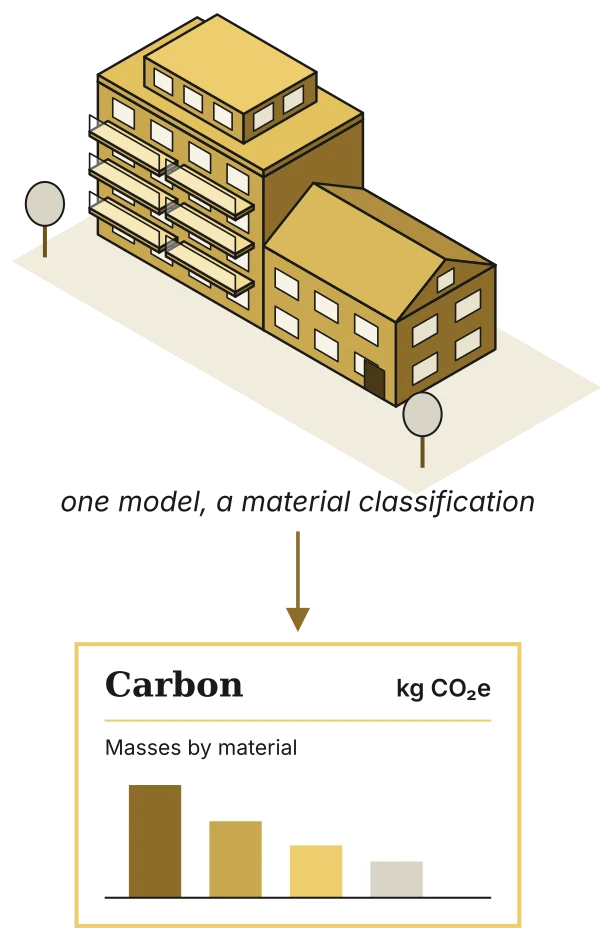
The same competence applied to a second classification. Instead of a cost classification, I apply a material classification to the model, and extract quantities and masses by material at the level of detail LCA software expects.
The standards behind life-cycle assessment are European: EN 15978, EN 15804 and ISO 14040/44 apply across Europe, and the quantities to be extracted do not change from one country to the next. The recast Energy Performance of Buildings Directive makes whole-life carbon calculation mandatory, starting with large new buildings and extending to all new construction by 2030.
I supply the input data. I do not sign the declaration. The assessment practitioner keeps responsibility for the calculation, its assumptions and its regulatory filing.
How the method works
Five phases, run as a loop. The loop matters: a model is a living document, and the preparation is re-applied at each revision rather than redone.
| Phase | What it does | What it means for you |
|---|---|---|
| Prepare | Analyse the model as received and correct what prevents it from being used | Your model becomes readable by any IFC tool — this is the precondition, not the work |
| Code | Attach each element to a code from your own framework | The link between model and cost library is embedded in the model and travels with the file |
| Structure | Reproduce your framework inside the model, from trade package down to item | Your nomenclature now lives inside the model, not in a spreadsheet beside it |
| Check | Verify two-way coverage between model and framework | No item without an element, no measurable element without an item |
| Reuse | Standardise the template, use the model downstream, re-apply at each revision | The work serves beyond the take-off, and is re-applied at the next revision for a fraction of the initial cost |
Any national framework
I work with the French DPGF — the itemised cost breakdown used in French tendering — and with the two Swiss classifications issued by CRB and used in French-speaking Switzerland: the CFC, by trade, for tendering, and the eCCC-Bât, by building element, for cost estimates. I am currently training a team there in the method, on both. The method does not change; only the classification file does.
I accept IFC models from any authoring tool. I ask no one to change the software they design in, and no one to change the software they estimate in. At the outset, I compare the results with those produced by the software I use; you then decide whether any adjustment is needed.
Who I work with
I am a practitioner, not a software vendor. I work with the tools that do the job, and I say so openly. That makes me a straightforward partner for:
- Software vendors whose users struggle with model preparation, and who need a method behind the tool — including training and first-project support for their customers.
- Classification and standards bodies looking to see their framework used natively inside models rather than re-keyed by hand in separate spreadsheets.
- Resellers and integrators who sell a capable tool and need someone who can make it deliver on a live project.
- Life-cycle assessment practitioners who currently rebuild material quantities by hand.
About Practical BIM
I founded Practical BIM in 2023 near Grenoble, France. I am an engineer with a PhD: sixteen years in high-precision manufacturing, then a move into construction cost management in 2012 — ten years in a cost consultancy, covering quantity surveying, cost planning and tender analysis, where I led the adoption of BIM.
Practical BIM is a certified training provider under the French Qualiopi scheme, and I teach BIM and construction cost management in French engineering schools and universities. What I teach is what I practise on live projects.
Get in touch
Tell me what your users, your members or your projects are stuck on. I will give you a straight answer on feasibility and scope before any commitment.
Get in touch